Rungta’s Webmarks
Tuesday, 23 January 2024
Bombay Velvet ∞
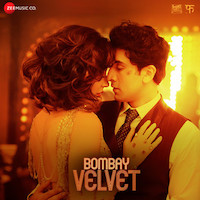
What a stunner of an album. Jazz in Bollywood. Amit Trivedi, and a host of singers1 having a ball! I’m yet to watch the movie that this is a soundtrack to, but the album I cannot get enough of.
Dhat teri
Iski har saza kubool ho jise
Yahan wohi wohi bari hua hai
Ispe jo mukadmaa kare
Aji wahi wahi mara hai
Released almost a decade ago in 2015, but feels as fresh as a well aged spirit. So many things to like here – music arrangements with the abundance of wind instruments and a diversity of quirky sounds rarely found in bollywood music, yet not one of them feels gimmicky or out of place. The ever changing rhythms and time signatures telling a story of their own with ample twists and surprises. (More three and half minute intros please, more trumpet solos please!)
Inki botal bhi goron ki gulaam hai
Roothi hai mehbooba
Roothi roothi sharaab hai
Hey aam hindustaani teri kismat kharaab hai
The lyrics, so conversational and the vocabulary so familiar that the commentary almost creeps up on you out of nowhere. The show-stealer though, hands down, is the vocals. The singers are in a league of their own.
-
Neeti Mohan, Shefali Alvares, Shalmali Kholgade, Papon, Mohit Chauhan ↩
Tuesday, 29 August 2023
Two Years on a Bike ∞
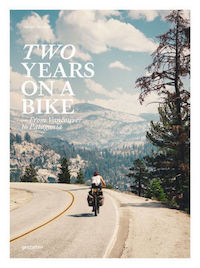
Martijn Doolaard, while sharing some history and context for his two year, twenty thousand kilometres long bicycle journey along the Pacific coast of the two American continents — from Vancouver to Patagonia:
I had quite a regular life, nothing to complain about, really, I think it is a good life. I am very grateful for it, but at the same time I was just missing a lot of things. I missed the connection with the natural world, being in the city. I missed working with my hands and using my body, and I missed getting physically tired, instead of mentally tired from watching screens all day and sitting inside, it just dulled me down. Also, the continuous rhythm of everything being the same at some point — like five days going to work, then there’s a weekend, then Monday everything starts over again, the same place, same kind of people… I needed to break the pattern.
Break the pattern.
(It’s been a long hiatus. I would be amiss not to address the almost eight year gap between this and the previous post, but I’ll plead guilty and leave it unaddressed. Instead, I want to talk about the incredible documentary that got me to break the silence on this blog.)
Martijn is a gifted storyteller. The production quality of this series is off the charts, which is not surprising once you learn that Martijn is a professional photographer himself. But there’s so much more. He takes his time, much like the way one has to find their body’s rhythm when undertaking any long strenuous physical activity. He invites you into his mind, which is often the stage for the largest struggles during any long journey, especially the more physically demanding ones. He talks about the people he meets and their stories, those building blocks of our memories and experiences. He shares the life-threatening reality of facing nature’s elements — wind, water, heat, altitude, and terrain — which otherwise appear trivially mundane in modern civilisation. And he takes us places. The redwood forests of California, the salt flats of Bolivia, the arid deserts of Utah, the many volcanoes along South America. Places known and unknown, explored and unexplored, magical, terrifying, stifling, but almost always utterly beautiful.
Perhaps you’ve been a cyclist all your life, perhaps you haven’t really been on a cycle since your school days. Perhaps you’ve taken to cycling recently, like me. There’s a lot to geek out on for cycling enthusiasts, but regardless of your enthusiasm for the two-wheeler, Two Years on a Bike is full of riches to give and very little to take.
- Watch the 4-part documentary: part 1, part 2, part 3, and part 4
- Get the book
- Follow Martijn on Instagram
(via Anshuman Manur, who aptly recommended this to me during my longest ride yet)
Friday, 6 November 2015
Humans Need Not Apply ∞
Bots be coming. Bots be outperforming. Bots be replacing. Watch out humans!
(via Steven Deobald)
Saturday, 31 October 2015

Standing By ∞
Back in 2011 I had come across a short talk by Arjun S Ravi about the formation of the indie music scene in India. It has been a few years and Arjun has kept himself busy. He has now come out with a full blown six-episode documentary series on the same subject called Standing By.
Beginning with the nation’s Independence and the exploration of the jazz scene in the country back then, the Standing By story then proceeds to the ’60s and ’70s and the rise of the beat groups, the mid-’70s to late ’80s with the nationwide spread rock and, later, metal, the ’90s with MTV and the music video explosion and finally to the dance music boom of the present day.
The first three episodes are out and they’re well worth a watch for any Indian alternate music fan.
Friday, 25 September 2015
“Just” ∞
Brad Frost on the unjustness of presumptions:
“Just clone the dev branch, add those three grunt tasks, and recompile…”
“Just use this software/platform/toolkit/methodology…”
“Just” makes me feel like an idiot. “Just” presumes I come from a specific background, studied certain courses in university, am fluent in certain technologies, and have read all the right books, articles, and resources. “Just” is a dangerous word.
More such dangerous words: quick, must, simply.
Update: Few more from Jason Fried: can’t, easy, only, fast.
Tuesday, 8 September 2015
Wrist-Stretches to Prevent RSI ∞
More and more of us spend extended hours locked in a single posture (typically seated in front of a computer) making ourselves prone to the dangers of Repetitive Strain Injury or RSI. I’ve started to feel the signs myself. Regular stretching, as shown in the linked video, is both highly effective and simple to adopt, and certainly the most inexpensive method to keep our hands in good shape. Timely and very useful to have come across it.
(via Frank Chimero)
Thursday, 3 September 2015
In Conversation: Quentin Tarantino ∞
Such a great, sprawling chat about politics, racism, casting, characters, longevity, the current crop of directors and more.
Monday, 24 August 2015
Music for 18 Musicians ∞
An enthralling, captivating, hour-long composition by Steve Reich, performed here by Eighth Blackbird. Fittingly discovered when I was riding light through the solar system.
This is my first introduction to Steve Reich and what appears to be his pioneering minimalist music. I can’t wait to dig deeper into his large body of work, and if this piece is any indication, I have some incredible hours of music ecstasy ahead. Joy!
Wednesday, 29 July 2015
The Fermi Paradox ∞
Sometimes the scale of the internet boggles the mind — the reach of a single tweet, the repercussions of a Wikipedia edit, the disruption caused by a buggy piece of software — but internet scale doesn’t even come close when you compare it to space. The scale of things in the universe is mostly unfathomable. Take the recent Pluto flyby for instance:
People don’t fully appreciate how incredible this is. Pluto is 7.5 billion km away. New Horizon speed is 50,000km/hr
The human mind cannot comprehend such numbers properly. We have absolutely no points of reference from our daily lives.
— Siddharth Singh (@siddharth3) 4:47pm and 4:48pm, 14 July 2015
7.5 billion kilometres. Spend some time with the fantastic If the Moon Was Only 1 Pixel model of the solar system to get a crude feel of what that can be like (because no human knows what it actually is like). But we’re still talking about just our solar system here. Things get really crazy when you go interstellar.
Now add to this the eternal question — are we alone in the universe? Go on, go read about the Fermi Paradox.
Saturday, 25 July 2015
Himalaya One: The Four Passes Trek ∞
Friends and avid trekkers Sriparna & Rohit (of Tiffinbox and Travelling Teadom fame):
We flagged off our secret ‘Himalaya One’ project in the summer of 2013. The first trek started in Naggar (Kullu Valley) and ended in Kafnu (Kinnaur Valley). The walk in between spanned 200 kilometres, 19 days and a little over 100 hours of walking. We have tried to compile the best of the footage captured in 6 minutes.
It’s hard showering praise on these Himalayan treks and not ending up sounding repetitive, but what the hell, this looks absolutely incredible. The exercise sequence in the beginning was such a clever way to exploit the GoPro. And secret ‘Himalaya One’ project? Hmm…
Thursday, 23 July 2015
Why I Hate Writing ∞
What better than a lament on the virtuous and therapeutic yet constantly avoided act of writing, by Natasha Badhwar, to revisit this forgotten and abandoned website.
Why did I stop writing? I could find many excuses — lack of time while trying to run a company, or wanting to distance myself from digital screens after staring at them throughout the workday, or getting slowly dispassionate with age, or a long-overdue design overhaul to improve the reading experience. They’re all true to some extent, but probably secondary. Ultimately the act of writing is the act of gaining clarity, of facing your demons, of covering the distance between hearing and listening.
That is what I’ve been running away from all this while.
Saturday, 11 January 2014

Letterboxd ∞
If you’ve ever maintained (or thought of maintaining) a crude list of the films you’ve seen, Letterboxd is for you. I’ve been using the site for almost an year now and I love it. I especially like how they track re-watches, have spoiler markers and make ample use of movie posters. There’s little doubt that Letterboxd is built, maintained and populated by film buffs, and it makes me feel right at home.
Saturday, 25 May 2013
The Curse of Reading and Forgetting ∞
Reminded me of an exchange between Rohit and myself, where we quipped:
Life is all about trying new things and repeating the good ones.
Monday, 29 April 2013
Here is Today ∞
An excellent visualisation of time, starting from 24 hours (today) and going all the way back to the creation of the universe. Created by Luke Twyman.
More such relative comparisons of scale that I really like:
- Powers of Ten — Zooming out (and then in) by a magnitude of 10 every second.
- Scale — What if other planetary bodies orbited the earth at the same distance as the moon?
- How Far is it to Mars …if the Earth were 100 pixels in diameter?
Wednesday, 13 March 2013
Delhi Hectic ∞
An “instagram [sic] based graphic novel” that takes us on a stark and introspective ride through contemporary middle-class Delhi. By someone who returned to a city he used to call home and found a lot had changed while he was away.
Reminded me of the short film Dilli. It has a similar narrative, but from the perspective of the aspirational labour class residents instead of the contemporary middle-class. (Trailer)
Tuesday, 26 February 2013
How People Learn ∞
Enlightening piece on how we humans go about learning.
A traditional science instructor concentrates on teaching factual knowledge, with the implicit assumption that expert-like ways of thinking about the subject come along for free or are already present. But that is not what cognitive science tells us. It tells us instead that students need to develop these different ways of thinking by means of extended, focused mental effort. Also, new ways of thinking are always built on the prior thinking of the individual, so if the educational process is to be successful, it is essential to take that prior thinking into account.
Most of us have undergone this multiple times over the course of our lives, but we’ve probably not been aware of the process in conscious details.
Friday, 23 November 2012
Where are we when we… think? ∞
Sciences describe the world. As far as I see, there is no way to describe the world absolutely; there is no description without language. Language is relative, language is contextual, language is human, language is faulty.
Any language is faulty. Even math, or better: maths, since there is not one math. There are many maths. Math is a mess. Math is as much a (basis of) natural science as it is (a basis of) a human science. Math describes us as much as it describes what we try to understand.
Which, again is a pretty wild claim that will make a lot of people angry. Not only scientists. But let them get angry while we move on to even more outrageous things.
Picking up right where we left off (wondering about objectivity in subjects) comes this provocative thought from Oliver Reichenstein — there doesn’t exist a clear separation between the subject and the object.
Or, this wonderful simplification:
“We do not see things as they are; we see things as we are.”
Monday, 24 September 2012
Art and Reaction ∞
At first I didn’t understand. What did she mean by “too much moisture”? She explained that the film looked too wet, that it was always raining, that there was… too much moisture. I didn’t [know] what to say.
Baradwaj Rangan has a “Bodhi-tree burst of enlightenment” that makes me ponder — can art ever be consumed objectively? Can anything?
Saturday, 28 July 2012
Of Onions, Kings, and the Cities of Delhi ∞
Anisha Shekhar Mukherji (conservational architect and author of books on the Red Fort and the Jantar Mantar) on the incoherent past and the often uninterested present of Delhi:
The city of Delhi sometimes reminds me of an onion, imperfectly taken apart - many layered, veined and maimed. The layers are not coherent or even tightly packed - scattered stray wisps forlornly curl at the edges in some corner, many centuries lie bunched together in another. Yet within them lie hidden vapours of many pasts, rising unbidden to sting you into an awareness of a different time.
Delhi has an extremely rich heritage, but ever changing hands from one disparate ruler to the next, it has never been one to linger on its past. Yet ignored as they may be, some traces do remain; faintly in the city’s culture but very visibly in its monuments.
An ordinary man, covering many kilometres in suffocatingly crowded public transport, does not retain the will to perceive former Delhis, smothered in the pursuit of the Delhi of today.
Which is a pity and ultimately, a great loss. Why not “[integrate] these former Delhis into the Delhi of today”, urges Anisha, while suggesting a plan for just such a process.
(via Dilli Dallying)
Friday, 13 July 2012
Hugo ∞
It’s been a while since I’ve written about a movie here, but it hasn’t been for a lack of memorable movies. If anything, it may be due to the spike in the number of movies that have been competing for my thinking time. But here is one that managed to persist – Hugo.
It is fascinating to see a movie such as Hugo come from the director of Taxi Driver and The Departed. I remember Rakesh once making a remark that these directors (then referencing Steven Spielberg) are just kids who now have the skill and resources to play out their fantasies in the grandest way possible. Hugo personifies that more beautifully than I can explain.
A Paris railway terminal (which the camera takes full advantage of) and the nostalgic 1900s time period would itself make for compelling backdrops to any movie, let alone one with an orphaned kid as the protagonist. So you would be forgiven for assuming that is what the film is all about after watching its misleading trailer. The real beauty of Hugo however, lies in its story. That fundamental human trait of curiosity, the joy of making things, tinkering, creating and storytelling all bound together beautifully (if a little indulgently) with the history of cinema itself. Hugo makes you fall in love with cinema, twice over again.
(Official Site | Wikipedia | Apple Trailers)